
1. Plant Origin (Source & Identity)
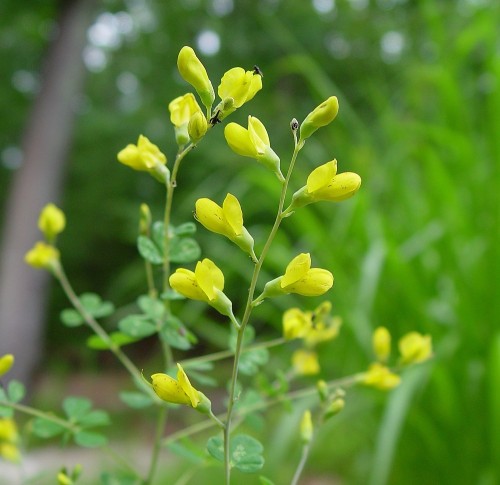
- Botanical name: Baptisia tinctoria
- Family: Fabaceae (Leguminosae)
- Common names: Wild Indigo, Yellow Indigo
- Natural habitat: Eastern North America; dry woods and open fields
- Part used: Fresh root
2. Extraction & Preparation (Homeopathic Methodology)
- The fresh root is harvested and macerated in alcohol to produce the mother tincture (Q).
- Subsequent triturations and serial dilutions are performed according to classical homeopathic pharmacopeial standards to achieve lower potencies, such as 3X.
Safety note: Crude Baptisia has physiological effects. Only use homeopathically prepared dilutions for medicinal purposes.
3. Core Sphere of Action
- Acts mainly on:
- Blood and septic states
- Nervous system
- Mucous membranes
- Gastrointestinal tract
- Central Theme: Septic conditions with profound prostration and mental confusion.
4. Key Repertory Rubrics for Baptisia tinctoria
- Mind: Confusion, delirium, sensation as if body parts are scattered
- Generalities: Profound weakness, prostration disproportionate to disease, offensive discharges
- Mouth & Throat: Putrid breath, ulcerated throat, difficulty swallowing
5. Comparative Remedies (Differentiation)
| Feature | Baptisia T. | Pyrogen | Arnica | Rhus tox |
|---|---|---|---|---|
| Septic state | Yes | Yes | Mild | No |
| Prostration | Profound | Profound | Bruised | Moderate |
| Mental state | Confused | Clear | Indifferent | Restless |
| Discharges | Offensive | Offensive | Mild | Mild |
6. Uses in Homeopathy
- Common (Acute) Conditions:
- Acute fevers with stupor
- Influenza with exhaustion
- Sore throat with putrid odor
- Chronic Ailments:
- Low-grade sepsis
- Chronic infections with weakness
- Slow recovery after fever
- Severe Conditions (Adjunctive only):
- Typhoid-like states
- Septicemia
Immediate medical care is essential in severe infections.
7. Constitutional Portrait (Type Most Affected)
- Individuals who collapse rapidly during illness
- Low resistance to infection
- Prone to toxic states
Constitutional action: Systemic toxicity overwhelms vitality, leading to mental and physical disintegration.
8. Potency & Practical Usage
| Potency | Pack Size | Clinical Use |
|---|---|---|
| 3X | 100 ml | Acute septic states, typhoid-like fever |
| 30C | 100 ml | Acute septic states with confusion |
| 200C | 100 ml | Deeper septic or post-infectious states |
- Dosage guidance: Low potency may be repeated cautiously in acute states with close observation. Discontinue once improvement is observed.
9. Effects in Children & Seniors
- Children:
- Severe fevers with stupor
- Putrid sore throat
- Seniors:
- Infections with collapse
- Marked weakness
Medical supervision is mandatory for these groups.
10. Documented Clinical Applications (References)
- Classical authors Hering, Clarke, and Boericke describe Baptisia tinctoria as useful for:
- Typhoid conditions
- Septic states
- Profound prostration
11. Sample Repertorization Chart
| Rubric | Baptisia | Pyrogen | Arnica | Rhus tox |
|---|---|---|---|---|
| Septic fever | 3 | 3 | 1 | 0 |
| Prostration | 3 | 3 | 2 | 1 |
| Mental confusion | 3 | 1 | 1 | 0 |
| Offensive discharges | 3 | 3 | 1 | 1 |
| Delirium | 2 | 1 | 0 | 0 |
This version is streamlined for clarity and visual organization, retaining key clinical and homeopathic details.
Clinical Insight
Baptisia tinctoria should be considered when a patient appears overwhelmed by infection, with weakness far exceeding the apparent severity of disease. The hallmark is a toxic mental state, where the patient feels disoriented or believes parts of the body are scattered. Early selection can support recovery when combined with appropriate medical care.
Clinically, Baptisia tinctoria is most effective in early to moderately advanced septic states, where the patient shows signs of systemic toxicity rather than localized inflammation. The prostration is often out of proportion to objective findings, and patients may appear mentally disconnected, slow to respond, or confused even when fever is not extreme. This mental dullness is a key guiding symptom.
Another important observation is the sensation of physical disintegration, where the patient feels as though body parts are separated or scattered. This peculiar symptom strongly differentiates Baptisia from other septic remedies. In throat infections, the presence of dark redness, ulceration, and foul odor further supports its selection.
Baptisia tinctoria should be considered early to support vitality while appropriate medical treatment addresses the underlying infection. Clinical response is usually seen as gradual improvement in clarity of mind, reduction of offensive discharges, and increased physical strength over time.
Conclusion
Baptisia tinctoria remains one of the most important homeopathic remedies for acute septic and typhoid-like conditions. Its timely use, careful monitoring, and integration with conventional treatment can help stabilize patients during severe infectious states.