
1) Plant Origin (Source & Identity)
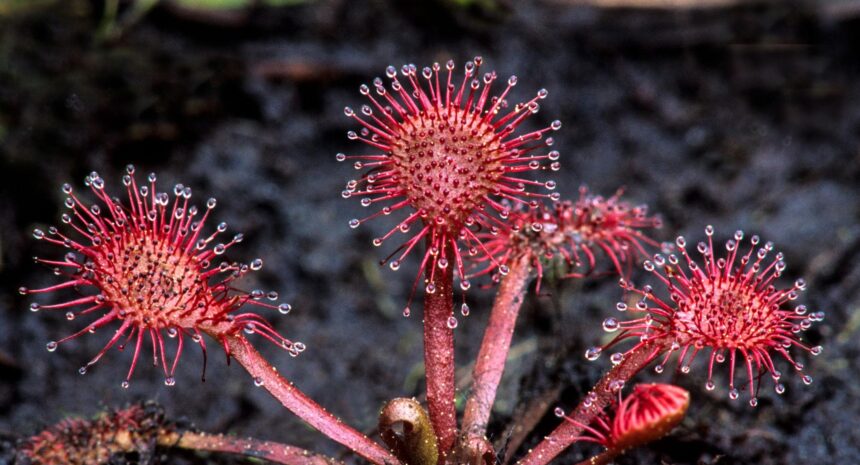
- Botanical Name: Drosera rotundifolia
- Family: Droseraceae
- Common Name: Sundew
- Natural Habitat: Marshy, boggy regions of Europe, North America, and Asia
- Part Used: Whole fresh plant
2) Extraction & Homeopathic Preparation
The fresh plant undergoes alcohol extraction to create the mother tincture (Q). This tincture is then subject to serial dilution and succussion to produce various potencies, including 3X, 30C, and 200C.
Safety Note:
Homeopathic potencies are generally safe when used correctly. Persistent or worsening cough and respiratory distress require professional medical evaluation.
3) Core Sphere of Action
Drosera primarily targets:
- Respiratory System: Spasmodic cough
- Throat and Larynx: Irritation, hoarseness
- Nervous System: Reflex spasmodic cough
- Chest: Tightness and breathing difficulty
Central Theme:
Violent, spasmodic coughs, notably worse after midnight.
4) Characteristic Symptoms & Keynotes
- Severe, spasmodic, whooping-type cough
- Cough worse after midnight, often in rapid spells
- Vomiting after coughing
- Hoarseness and throat irritation
- Cough triggered by talking or laughing
- Deep, barking cough
Keynote:
Spasmodic cough, worse after midnight, with choking sensation.
5) Key Repertory Rubrics
- Cough – spasmodic
- Cough – night – after midnight
- Cough – whooping
- Cough – with vomiting
- Larynx – irritation
6) Comparative Remedies (Differentials)
| Feature | Drosera | Spongia | Ipecac |
|---|---|---|---|
| Cough type | Spasmodic, whooping | Dry, barking | With nausea |
| Time | After midnight | Before midnight | Variable |
| Vomiting | Common | Rare | Marked nausea |
| Trigger | Talking/laughing | Cold air | Mucus |
7) Therapeutic Uses in Homeopathy
Common (Subacute Conditions):
- Spasmodic dry cough
- Whooping cough
- Night cough
Chronic Conditions:
- Recurrent spasmodic cough
- Chronic throat irritation
- Laryngeal sensitivity
Severe Conditions (Adjunctive Only):
- Severe respiratory spasms
- Persistent whooping cough
Note: Severe respiratory illness always requires medical supervision.
8) Constitutional Portrait (Who Benefits Most)
Drosera is suited to individuals who:
- Experience violent coughing fits
- Have coughing episodes worse at night
- Vomit after coughing
- Suffer from throat and laryngeal sensitivity
- Endure repeated spasmodic cough attacks
Often beneficial in children suffering from whooping cough.
9) Potency & Practical Usage
| Potency | Pack Size | Clinical Role |
|---|---|---|
| 3X | 100 ml | Acute cough and early respiratory irritation |
| 30C | 100 ml | Spasmodic and whooping cough |
| 200C | 100 ml | Chronic or severe spasmodic cough |
Dosage Guidance:
- Use 3X for mild or early-stage cough
- Use 30C for active spasmodic cough
- Use 200C for chronic or severe cases under supervision
- Discontinue once improvement is observed
10) Effects in Children & Seniors
Children:
- Highly effective for whooping cough
- Reduces cough intensity and frequency
Seniors:
- Helpful for chronic dry cough
- Supports overall respiratory comfort
Medical supervision is advised for all age groups in persistent or severe conditions.
11) Clinical Insights
Drosera rotundifolia is a cornerstone homeopathic remedy for spasmodic and whooping cough, characterized by coughing fits that are more intense after midnight and may be accompanied by vomiting. The remedy acts primarily on the respiratory and nervous systems, helping to reduce cough reflex sensitivity and improve breathing comfort. Persistence or severity in symptoms should always prompt proper medical assessment.
12) Sample Repertorization Chart
| Rubric | Drosera | Spongia | Ipecac |
|---|---|---|---|
| Spasmodic cough | 3 | 2 | 2 |
| Worse after midnight | 3 | 1 | 1 |
| Whooping cough | 3 | 2 | 2 |
| Vomiting after cough | 3 | 1 | 3 |
| Laryngeal irritation | 3 | 3 | 2 |
Conclusion
Drosera rotundifolia is a valuable homeopathic remedy for spasmodic and whooping cough, particularly when symptoms worsen after midnight. Available in 3X, 30C, and 200C potencies in 100 ml packs, it supports respiratory comfort and reduces coughing intensity. When used appropriately under professional guidance, Drosera helps restore respiratory balance and improve overall breathing comfort.
Drosera rotundifolia also demonstrates the importance of addressing the nervous reflex component involved in spasmodic coughing. Patients requiring this remedy often experience repeated, exhausting cough episodes that interfere with sleep and daily functioning. By gently calming the heightened cough reflex and supporting respiratory stability, Drosera promotes more regular breathing patterns and gradual recovery. Careful potency selection, proper monitoring, and supportive measures such as adequate hydration and medical evaluation further enhance its effectiveness. When prescribed on clear characteristic indications, Drosera rotundifolia remains a reliable remedy for managing persistent spasmodic cough and restoring respiratory well-being.