

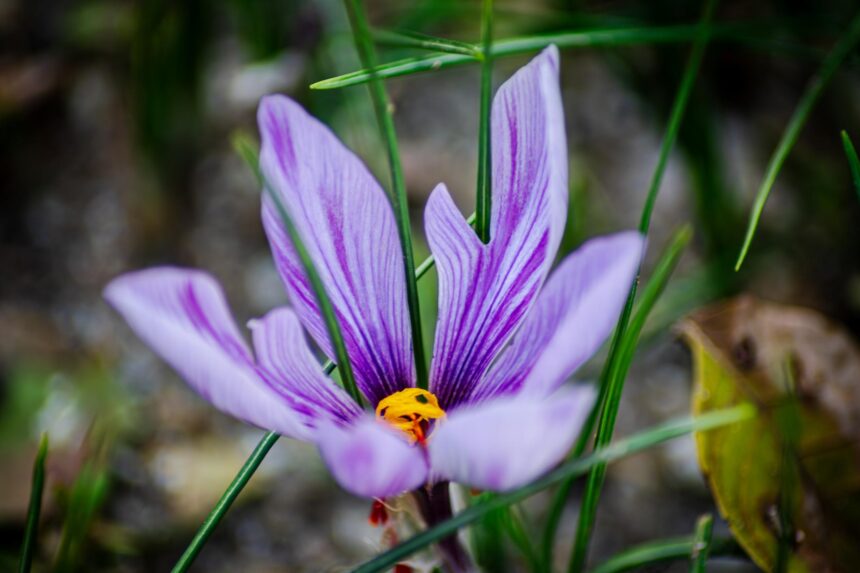
1. Plant Origin (Source & Identity)
- Botanical Name: Crocus sativus
- Family: Iridaceae
- Common Name: Saffron
- Natural Habitat: Mediterranean region and Southwest Asia
- Part Used: Dried stigmas of the flower
2. Extraction & Homeopathic Preparation
The dried stigmas are first triturated, then processed into a mother tincture (Q). This base is subsequently diluted and succussed in accordance with official homeopathic pharmacopeial standards to create the various potencies.
Safety Note: Saffron in crude doses has medicinal action, but homeopathic preparations are highly diluted and safe when produced by licensed pharmacies.
3. Core Sphere of Action
Crocus sativus primarily acts on:
- The circulatory system
- The female reproductive system
- The nervous system
- The emotional sphere
Central Theme:
Dark, stringy bleeding accompanied by emotional excitement.
4. Characteristic Symptoms & Keynotes
- Menstrual flow: dark, clotted, stringy blood
- Hemorrhage with long, black clots
- Sensation as if something alive is moving in the abdomen
- Sudden and marked emotional changes
- Alternating cheerfulness and sadness
- Hysterical laughter
- Restlessness
Keynote:Dark, clotted bleeding with emotional variability.
5. Key Repertory Rubrics
- Female – menses – dark, clotted
- Hemorrhage – black clots
- Abdomen – sensation – something alive
- Mind – alternating moods
- Mind – hysterical laughter
6. Comparative Remedies (Differential Diagnosis)
| Feature | Crocus Sat. | Sabina | Pulsatilla |
|---|---|---|---|
| Bleeding color | Dark, stringy | Bright red | Changeable |
| Emotional state | Excited | Irritable | Mild |
| Clots | Long, black | Red clots | Few |
| Mood swings | Marked | Moderate | Gentle |
7. Therapeutic Uses in Homeopathy
Common (Subacute) Conditions:
- Menstrual irregularities
- Dark uterine bleeding
- Emotional instability
Chronic Conditions:
- Recurrent uterine hemorrhage
- Mood variability
- Functional uterine disorders
Severe Conditions (Adjunctive Only):
- Heavy bleeding
8. Constitutional Portrait (Indications)
Crocus sativus is most suitable for individuals who:
- Are emotionally excitable
- Experience dark, clotted menstrual bleeding
- Have sudden mood swings
- Report odd abdominal sensations
Often indicated in young women with emotional and menstrual irregularities.
9. Potency & Practical Usage
| Potency | Pack Size | Clinical Role |
|---|---|---|
| 30C | 100 ml | Uterine bleeding and emotional symptoms |
Dosage Guidance:
- Use cautiously in bleeding cases
- Repeat based on symptom response
- Discontinue once bleeding normalizes
10. Effects in Children & Seniors
Children:
- Rarely indicated; may be used for emotional lability
Seniors:
- May be considered for post-menopausal bleeding (adjunctive only; pathology must be ruled out)
11. Expanded Clinical Insights
Clinically, Crocus sativus is recognized by dark, stringy, clotted bleeding, often with emotional excitement or mood swings. The peculiar abdominal sensation of something moving is a hallmark. Crocus Sat. is distinguished from Sabina (which features bright red bleeding and pronounced uterine pain) by its dark blood and emotional variability. It’s especially useful in functional uterine disorders where psychological and physical symptoms coexist. Improvement is marked by mood stabilization and normalized menstrual flow.
12. Sample Repertorization Chart
| Rubric | Crocus Sat. | Sabina | Pulsatilla |
|---|---|---|---|
| Dark clotted bleeding | 3 | 1 | 1 |
| Emotional excitement | 3 | 2 | 2 |
| Mood swings | 3 | 1 | 2 |
| Abdominal sensation | 3 | 0 | 0 |
| Hemorrhage | 3 | 3 | 2 |
Conclusion
Crocus sativus holds a distinct place in homeopathy for managing uterine bleeding marked by dark, stringy clots and emotional variability. Its dual action on the circulatory and nervous systems makes it especially useful when physical symptoms are intertwined with heightened emotional states.
In clinical practice, Crocus sativus is often considered when uterine bleeding presents with a peculiar characteristic of dark, viscid, and string-like clots that may hang in long threads. This distinctive keynote symptom greatly assists in remedy selection. Patients requiring this remedy may also exhibit marked emotional sensitivity, alternating between cheerfulness and sadness, or displaying sudden mood shifts that appear disproportionate to circumstances. The close relationship between circulatory disturbances and emotional excitability reflects the remedy’s broader sphere of action on both vascular tone and nervous regulation. By addressing these interconnected dimensions, Crocus sativus exemplifies the homeopathic principle of treating the individual as a whole, supporting not only symptomatic control of abnormal bleeding but also greater emotional equilibrium and overall reproductive health.