
1. Plant Origin (Source & Identity)
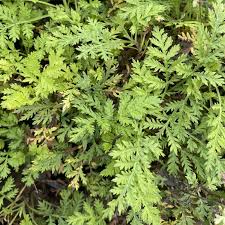
- Botanical Name: Artemisia vulgaris
- Family: Asteraceae
- Common Names: Mugwort, Common Wormwood
- Natural Habitat: Europe, Asia, North America; typically found along roadsides, in fields, and wastelands
- Part Used: Fresh aerial parts (leaves and flowering tops)
2. Extraction & Preparation (Homeopathic Methodology)
- The plant’s fresh aerial parts are harvested at the flowering stage.
- Preparation involves maceration in alcohol to produce the mother tincture (Q).
- The tincture is then serially diluted and succussed according to classical homeopathic pharmacopoeial standards to obtain centesimal potencies.
Safety Note: Crude Artemisia exhibits physiological activity. Only homeopathically prepared potencies should be used therapeutically.
3. Core Sphere of Action
Artemisia vulgaris mainly affects:
- The nervous system
- Brain and spinal cord
- Female reproductive system
- Digestive tract
Central Clinical Theme:
Sudden nervous disturbances presenting as spasms, convulsions, or functional irritation of the brain.
4. Key Repertory Rubrics for Artemisia vulgaris
Mind & Nervous System:
- Sudden convulsions
- Loss of consciousness
- Nervous excitability
- Epileptiform attacks
Generalities:
- Sudden onset of symptoms
- Spasmodic conditions
- Periodic nervous attacks
Female System:
- Menstrual irregularities with nervous symptoms
- Suppressed menses followed by convulsions
5. Comparative Remedies (Differentiation Table)
| Feature | Artemesia V. | Cicuta | Belladonna | Cuprum |
|---|---|---|---|---|
| Convulsions | Sudden, functional | Violent, distorted | Congestive | Spasmodic |
| Consciousness | Lost temporarily | Disturbed | Delirious | Clear |
| Trigger | Nervous irritation | Head injury | Heat/congestion | Exhaustion |
| Periodicity | Marked | Less | Sudden | Recurrent |
6. Clinical Insights
Artemisia vulgaris is especially valuable in functional nervous disorders that arise suddenly and without structural brain disease. It is indicated in epileptiform attacks, fainting spells, or spasmodic conditions triggered by nervous irritation, hormonal changes, or digestive disturbances.
Neurological symptoms often alternate with digestive or menstrual irregularities. Artemisia vulgaris is especially indicated when convulsions or fainting episodes follow suppressed menses, indigestion, or emotional shock.
- For violent, distorted convulsions: consider Cicuta
- For predominant congestion and heat: consider Belladonna
7. Uses in Homeopathy
Acute Ailments:
- Sudden fainting spells
- Nervous spasms
- Acute epileptiform attacks (as supportive care)
- Functional nervous collapse
Chronic Ailments:
- Functional (non-structural) epilepsy
- Chronic nervous irritability
- Menstrual-related nervous disorders
- Recurrent fainting episodes
Extreme Cases (Adjunctive only):
- Severe convulsive disorders
- Loss of consciousness
Note: Neurological evaluation is essential in seizure disorders.
8. Constitutional Portrait
- Suits nervous, sensitive individuals
- Patients prone to abrupt, functional collapse
- Women with hormonal and nervous imbalances
- Symptoms characteristically appear suddenly
Constitutional Action: The nervous system reacts violently yet functionally, without underlying degeneration.
9. Potency and Practical Usage
| Potency | Pack Size | Clinical Role |
|---|---|---|
| 30C | 100 ml | Sudden nervous attacks, fainting |
| 200C | 100 ml | Chronic convulsive tendency |
Dosage Guidance: Lower potencies may be used for acute episodes with caution. Higher potencies are reserved for chronic cases and given infrequently with close observation.
10. Effects / Considerations in Children and Seniors
Children:
- Functional convulsions
- Febrile or nervous seizures (always under medical supervision)
Seniors:
- Nervous fainting
- Spasmodic weakness (exclude cardiovascular or neurological disease)
11. Documented Clinical Applications
Classical homeopathic sources (e.g., Clarke, Boericke) report use of Artemisia vulgaris in:
- Epilepsy
- Convulsive disorders
- Nervous collapse without organic cause
The remedy is traditionally selected when functional disturbances predominate over structural pathology.
12. Key Repertory Rubrics (High-Yield)
- Convulsions – sudden
- Epilepsy – functional
- Fainting – nervous origin
- Menses – suppressed with convulsions
- Generalities – sudden onset
13. Comparative Remedies (Main Differentials)
- Cicuta virosa: Violent convulsions, distortion
- Belladonna: Congestion, heat, delirium
- Cuprum metallicum: Exhaustive spasms
14. Clinical Decision Tips
Select Artemisia vulgaris when:
- Convulsions are sudden and functional
- No structural brain pathology is evident
- Nervous symptoms follow menstrual or digestive disturbance
- Attacks occur periodically
15. Sample Repertorization Chart
| Rubric | Artemesia V | Cicuta | Belladonna | Cuprum |
|---|---|---|---|---|
| Sudden convulsions | 3 | 3 | 2 | 2 |
| Functional epilepsy | 3 | 2 | 1 | 2 |
| Loss of consciousness | 2 | 2 | 2 | 1 |
| Nervous irritability | 3 | 2 | 2 | 1 |
| Periodicity | 3 | 1 | 1 | 2 |
Artemisia vulgaris is best suited for sudden, functional nervous disturbances where convulsions or fainting occur without clear structural pathology.